OpenAI Ads Manager Beta: What We Learned Testing ChatGPT Advertising for AdMax Local
AI is increasingly changing how consumers find brands, evaluate suppliers, and make purchasing decisions. With hundreds of millions of users using AI assistants like ChatGPT for research, recommendations, and problem-solving, the next logical step was inevitable: advertising within conversational AI. This week, OpenAI expanded access to its self-serve Ads Manager Beta, allowing more U.S. businesses to launch campaigns directly inside ChatGPT. While OpenAI initially introduced advertising through select partnerships with major holding companies and enterprise advertisers, this broader rollout marks the first true opportunity for smaller brands and agencies to test conversational advertising firsthand. As such, I was excited to test out ChatGPT ads. Typically, at AdMax Local, we have a philosophy that new channels should be carefully tested, particularly if they have the potential to completely change the direction of digital marketing. We therefore decided to test the platform ourselves rather than speculate.
Here's what we learned.
The Shift From Audience Targeting to Conversational Intent
Traditional digital advertising platforms are built around predictable targeting models.
Google Ads focuses on search intent.
Meta Ads focuses on audience behavior, demographics, and algorithmic signals.
OpenAI Ads introduces something fundamentally different: contextual conversational targeting.
Instead of targeting someone searching "digital marketing agency near me," advertisers can potentially appear when users ask nuanced questions like:
- "What's the best digital marketing agency for a multi-location business?"
- "How can I improve lead quality from paid search?"
- "Should I hire an agency or manage Google Ads myself?"
That shift is significant.
Rather than optimizing solely around keywords or predefined audiences, marketers can now align advertising with real-time conversation intent.
This could represent one of the most important changes in paid media since social advertising became mainstream.
Our Test: A Small Brand Awareness Pilot for AdMax Local
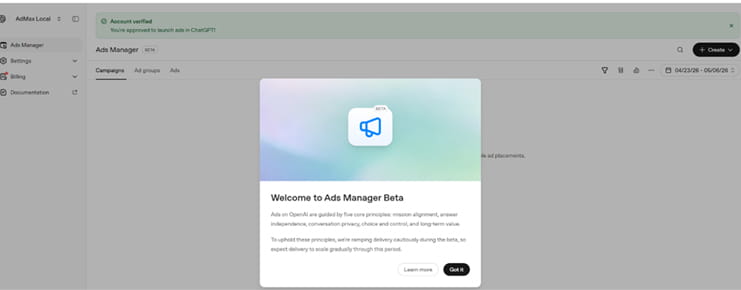
Because this is an early beta product, we approached OpenAI Ads the same way we'd recommend most advertisers approach any emerging channel: cautiously.
Instead of launching a large-scale lead generation campaign, we created a small-budget brand awareness test for AdMax Local designed to help us understand platform behavior, ad setup, targeting controls, and pacing.
We launched three ad creatives centered around AdMax Local's positioning as an agency that combines AI-powered marketing with human expertise.
Our primary goals were simple:
- Understand how easy it is to set up the platform.
- Evaluate how contextual targeting works.
- Monitor spend pacing behavior.
- Assess available reporting.
- Observe click engagement trends.
- Identify operational limitations.
This was not a direct-response ROAS test.
It was an exploration.
And that's exactly how marketers should frame OpenAI Ads today.
The Setup Experience
The good news?
Getting started was surprisingly straightforward.
The platform currently uses a familiar paid media structure:
Campaign → Ad Group → Ad
At the campaign level, advertisers can choose from:
- Clicks
- Reach
- Conversions
You can define:
- Campaign budget
- Start and end dates
- Conversion events (if using conversion tracking)
At the ad level, setup is intentionally lightweight.
Current ad creation includes:
- Destination URL
- Headline
- Description
- Image upload
This is nowhere near the sophistication of Google Ads or Meta Ads Manager, but that's expected for an early beta.
Agency Workflow Consideration
One operational limitation worth noting:
OpenAI does not currently support MCC-style account structures.
That means agencies cannot simply create and centrally manage multiple client accounts, as they can in Google Ads.
Instead:
- The client must create the account.
- Billing is configured by the client.
- Agencies or internal teams are invited afterward.
For agencies managing multiple advertisers, this creates some friction.
The Most Interesting Feature: Context Hints
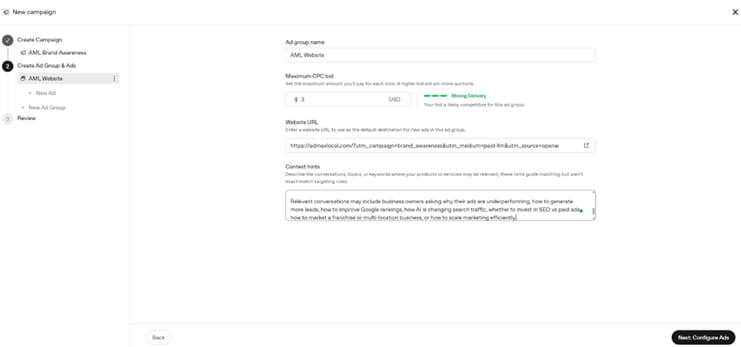
This is where OpenAI Ads truly stand out.
Instead of selecting audience interests, demographics, placements, or keyword match types, advertisers provide Context Hints.
This means describing the conversations where your ad should be relevant.
Examples include:
- Topics
- User questions
- Keywords
- Conversation themes
- Purchase intent scenarios
In other words, advertisers are effectively prompt-engineering targeting.
Example:
Instead of targeting:
Digital marketing agency
You might describe:
"Business owners researching paid search management, lead generation strategies, or comparing digital marketing agencies for growth support."
This changes the strategic mindset significantly.
The quality of your contextual input may become just as important as your bid strategy.
Tracking & Measurement
OpenAI currently supports:
- JavaScript pixel tracking
- Conversion API (CAPI) integrations
That's encouraging for performance marketers, though attribution maturity remains limited compared to established platforms.
Current reporting metrics include:
- Impressions
- Clicks
- Spend
- CTR
- Average CPM
- Average CPC
If you're used to advanced breakdowns, attribution modeling, audience insights, assisted conversion reporting, or offline CRM integrations, expectations should remain modest for now.
Our Biggest Learning: Budget Pacing Can Move Fast
Our original plan was to let the campaign run across a two-week learning period.
The objective was to gather directional data without forcing spending too aggressively.
Then we made a change.
To improve delivery and competitiveness, we increased CPC bids.
The result?
The entire budget was spent in less than a week.
That was our clearest operational lesson from this beta.
Unlike mature ad platforms that have years of safeguards against pacing, automated bid smoothing, and refined delivery controls, OpenAI's Ads Manager still appears relatively aggressive when bids increase.
That doesn't mean the platform is flawed.
It means it's early.
For advertisers testing this channel, our recommendation is simple:
- Start with smaller budgets.
- Monitor spending daily.
- Increase bids cautiously.
- Treat pacing as volatile.
If you approach this like Google Ads and assume incremental scaling, you may burn through your budget faster than expected.
Emerging Best Practices
Based on our experience and broader industry observations, a few early best practices are becoming clear.
Keep Messaging Tight
Because ads appear within conversational experiences, brevity matters.
Emerging recommendations suggest:
- Headlines around 16 characters.
- Descriptions around 32 characters.
This is dramatically shorter than many other platforms.
Avoid Logo-Heavy Creative
Early feedback suggests that logos alone are weak performers.
Benefit-driven imagery or visually relevant creative appears to align better with the environment.
Think Like a Conversation Strategist
Traditional keyword thinking is not enough.
Ask:
- What questions are users asking?
- What conversations signal buying intent?
- Where does my solution naturally fit?
That mindset will likely outperform rigid keyword logic.
Who Should Test OpenAI Ads Right Now?

This is not a universal fit yet.
However, certain advertiser categories may benefit from early experimentation:
- SaaS companies
- Digital product brands
- Education providers
- Local service businesses
- Travel brands
- Entertainment companies
- AI-native businesses
- Agencies exploring emerging channels
Brands that should likely proceed cautiously:
- Highly regulated industries
- Low-margin ecommerce
- Performance-only advertisers demanding deterministic attribution
- Enterprise programs needing deep controls
The Bigger Strategic Takeaway
The most important insight from this test is not campaign performance.
It's market direction.
Consumers are increasingly shifting discovery behavior from traditional search engines toward conversational AI platforms.
Advertising will follow that behavior.
The strategic question is no longer whether AI advertising becomes a meaningful channel.
It's how quickly the ecosystem matures.
Google will evolve.
Meta will evolve.
And OpenAI's approach to context-based advertising may influence how all major platforms think about targeting.
Where OpenAI Ads Go From Here
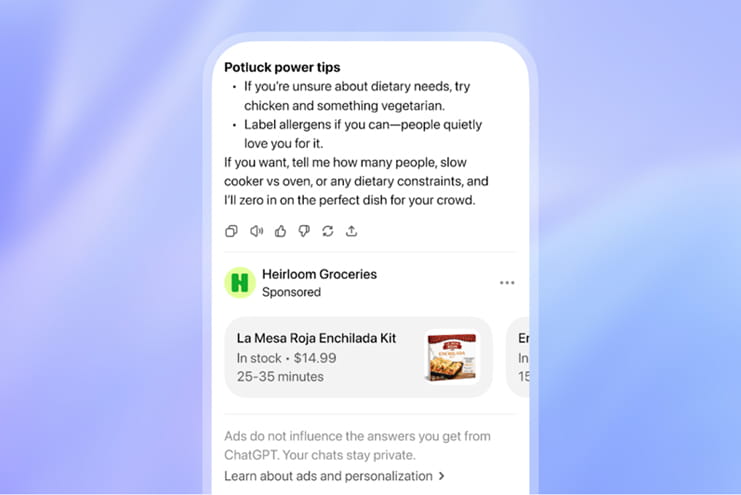
OpenAI's Ads Manager Beta is clearly still in its infancy.
The controls are basic.
Reporting is limited.
Workflow constraints exist.
Pacing needs refinement.
But the underlying concept is genuinely compelling.
For AdMax Local, this was exactly the type of emerging platform experiment worth running, not because we expected immediate performance wins, but because understanding tomorrow's channels today creates strategic advantages.
Our recommendation?
Treat OpenAI Ads as an innovation sandbox, not a core acquisition engine yet.
Start small.
Test deliberately.
Learn fast.
Because conversational advertising is no longer theoretical.
It's here.
And this is likely just the beginning.
Posted On : 05-12-2026
Author : Patrick Dean Hodgson
Latest Blogs
Archives
No archives